
Zendesk and Forethought: Turning the Resolution Platform to Eleven
Zendesk’s acquisition of Forethought marks a major leap in customer service automation. Combining platform depth with Forethought’s multi-agent AI, Zendesk pioneers a self-improving, omnichannel Resolution Platform that transforms customer support from reactive tickets to proactive processes.

Zendesk and Forethought: Turning the Resolution Platform to Eleven
Zendesk’s acquisition of Forethought marks a major leap in customer service automation. Combining platform depth with Forethought’s multi-agent AI, Zendesk pioneers a self-improving, omnichannel Resolution Platform that transforms customer support from reactive tickets to proactive processes.

On this page
The ideas stated in this article are based on publicly available information from Zendesk's Newsroom and the Forethought website. It is not a reflection of Zendesk's actual product strategy.
For Zendesk's official newsroom statement, please read the newsroom post linked below.
Agentic AI is quickly becoming the new normal for customer service. The ability to resolve inquiries automatically, end to end, is no longer a differentiator. It's the baseline.
Zendesk's Resolution Platform was built for exactly this moment. Omnichannel AI Agents, Agent Copilot, QA, Analytics. All working together to drive automated resolutions at scale. The dial is already at ten.
With Forethought, Zendesk is turning it to eleven.
This proposed acquisition, expected to close by end of March 2026, will accelerate their product roadmap significantly. Adding Forethought to our portfolio is more than a feature addition though. It's another major step in our process of moving from system of record towards an intelligent system of action.
For over a decade, Zendesk was a ticketing company. Then it grew into an omnichannel platform. At Relate 2025 it rebranded as a Resolution Platform. Forethought pushes it somewhere new entirely: a self-improving system of action where process, not the ticket, sits at the centre.
What is Forethought
Forethought was founded in 2017 and won TechCrunch Battlefield in 2018. That's four years before ChatGPT existed. By 2025 it was processing over one billion monthly customer interactions for companies like Airtable, Grammarly, Datadog, Upwork and UPS.
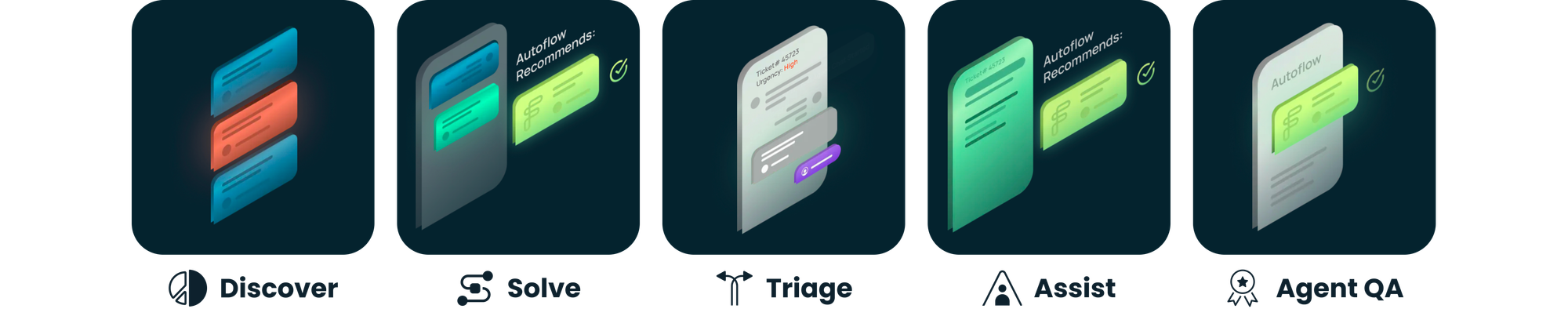
The platform is built on a multi-agent architecture. Five specialised AI agents each handle a different part of the support lifecycle. If you know Zendesk's product line, most of these will sound familiar. There's an overlap, which makes Forethought a great way to augment what we already have. But there's also differences, it fills some gaps the platform currently has.
Multi-agent architecture
Forethought doesn't run on a single monolithic AI. Each of their five Agents has a distinct role, but they share context and workflows across the system. Here's how they compare to what Zendesk offers today.
Discover
Discover is the intelligence layer. It connects to your helpdesk, knowledge base and CRM on day one and analyses historical ticket data. It surfaces trending issues, top contact drivers and emerging support patterns. More importantly, it identifies knowledge gaps and then auto-generates both articles and Autoflow workflows to fill them.
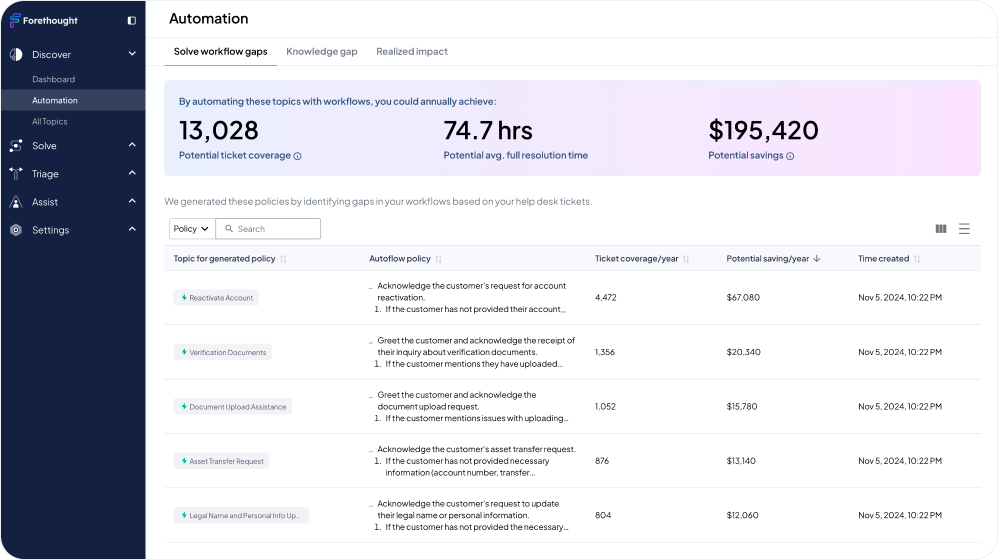
Zendesk's closest parallel is a combination of Intelligent Triage and AI Insights. Intelligent Triage detects intent, sentiment and language. AI Insights flags outdated or underperforming articles, or suggest new procedures to write. But neither closes the loop the way Discover does. AI Insights tells you an article needs attention. Discover drafts a new one and builds a workflow to go with it. That "find the gap, then create the fix" cycle is something Zendesk hasn't shipped natively.
These self-learning systems are the future of service, a future we intend to lead. - Shashi Upadhyay - President of Product, Engineering, and AI at Zendesk
Solve
Solve is Forethoughts' customer facing AI agent. It handles end-to-end ticket resolution across chat, email, voice, SMS, Slack, mobile and API. It's powered by Autoflows, which we'll get into in the next section. It detects intent, executes actions like processing refunds or updating accounts via API, and deploys identically across all channels from a single workflow definition.
The Zendesk parallel is AI Agents Advanced, the product line that grew out of the Ultimate acquisition. Both aim for autonomous resolution. The core difference is in how you build the logic. Zendesk AI Agents use structured conversation flows (dialogue builders or agentic procedures) that describe the steps to take.
Solve uses Autoflows: plain natural language outcome descriptions. It also trains on historical ticket data automatically and claims setup in under 24 hours. And critically, it was built to work on any helpdesk. Salesforce, Intercom, Freshdesk. Not just Zendesk.
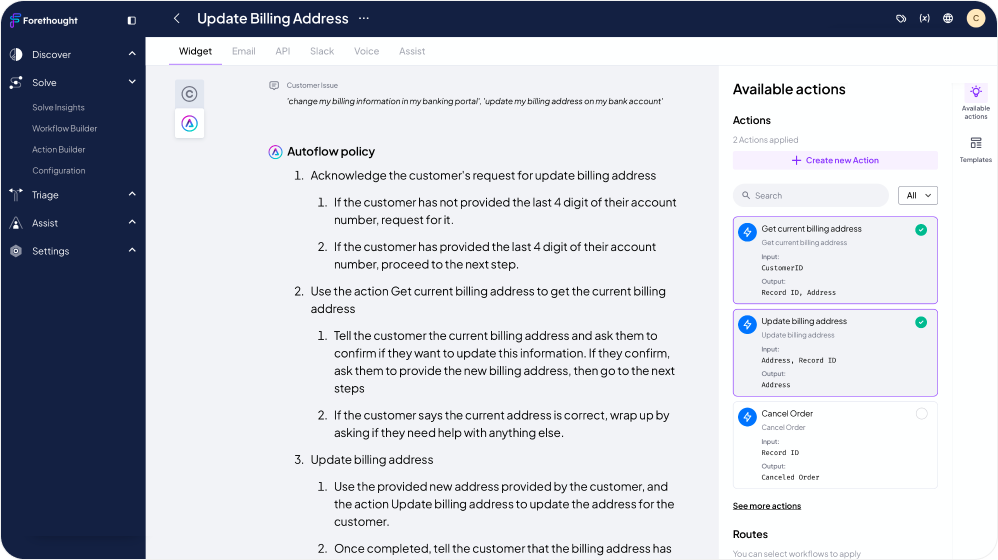
Until now, the power of Zendesk AI agents could only be leveraged through our own service platform. Once the Forethought acquisition closes, however, we will be extending Forethought’s capabilities to make agentic, self-improving systems available to all service teams.
While these agents work best within Zendesk, progress toward agentic service should not be limited by the systems teams use today. - Shashi Upadhyay - President of Product, Engineering, and AI at Zendesk
Another difference is that Solve has a single AI Agent for Messaging, Voice, Email and API (headless). This means that, while you can make the behaviour still unique, it shares intent detection, action flows, integrations e.a. making it a more cohesive solution than Zendesk's current channel based AI Agents.
Triage
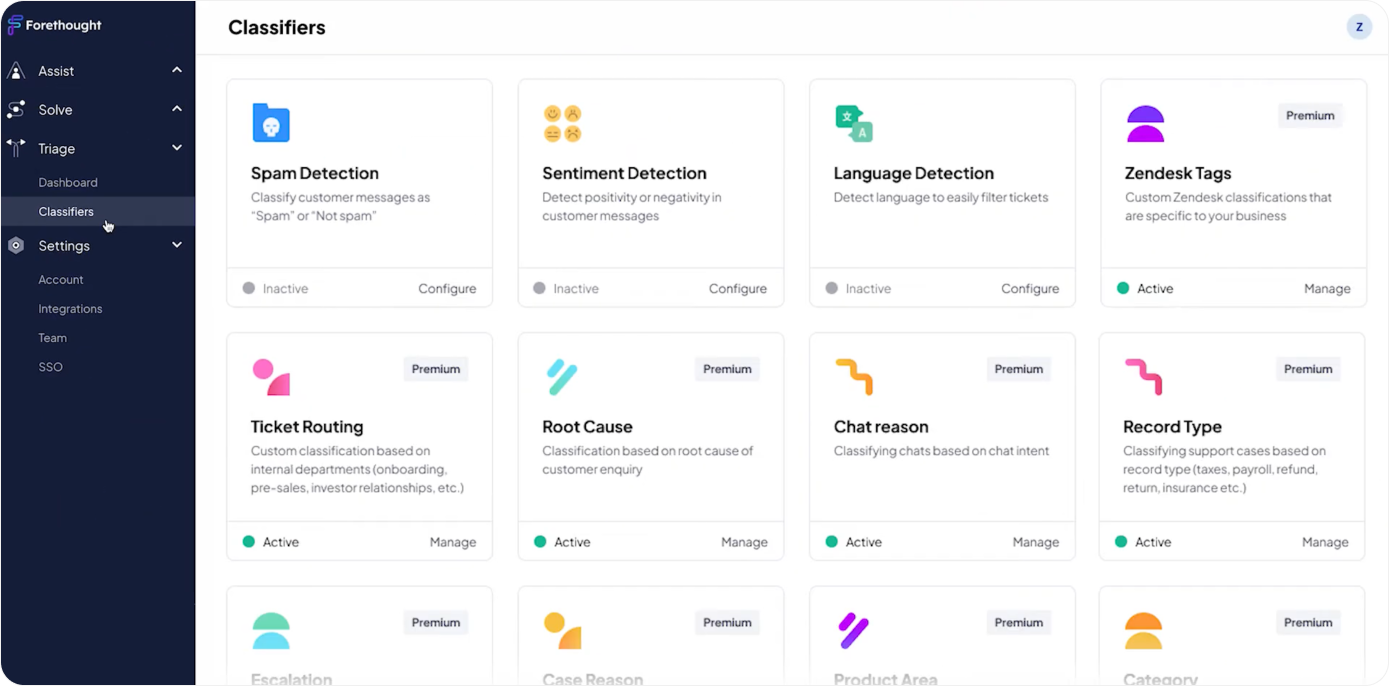
When Solve can't fully resolve, or when a customer asks for a human, Triage handles the handoff. It performs sentiment analysis, language detection, auto-tagging by topic, product, region and urgency, spam filtering and priority scoring.
This maps closely to Zendesk's Intelligent Triage combined with Omnichannel Routing. The capabilities are broadly similar. Both detect intent, sentiment and language. Where Forethought differentiates is in custom model building. Where Intelligent Triage has its Entities, with Triage users can train their own classification models for specific business taxonomies, for example by product type and region. The other edge is tighter integration. Triage sits inside the same system as Solve and Assist, so the handoff from AI to human is a single chain rather than a transition between separate products.
Assist
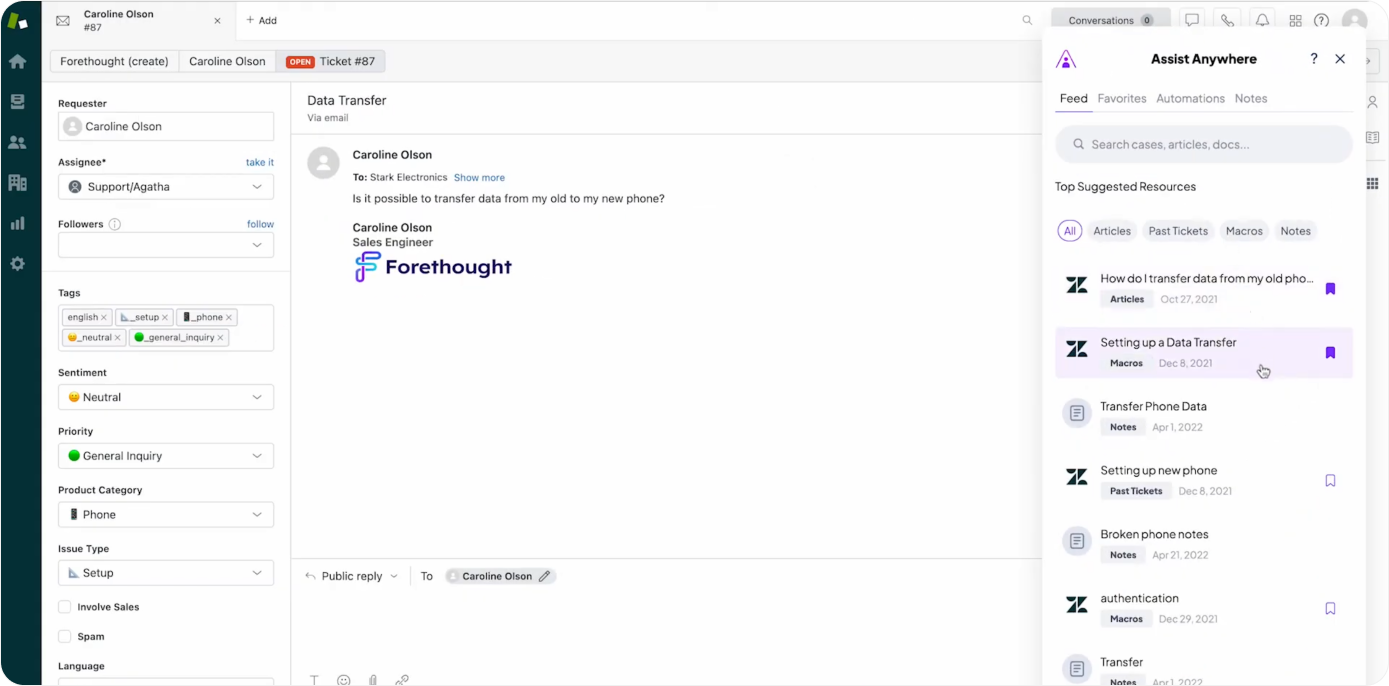
For tickets that reach human agents, Assist acts as a real-time copilot inside the helpdesk. It summarises conversation history, generates draft replies based on context and knowledge, and walks agents through complex resolution steps using Autoflows.
The Zendesk parallel is Agent Copilot. Both offer ticket summarisation, suggested responses and contextual knowledge surfacing. The key Forethought differentiator is that Assist can use the same Autoflows as Solve. The AI copilot guides agents through the exact same resolution logic that the AI agent would use autonomously. This creates consistency between automated and human-handled interactions. In Zendesk today, AI Agent procedures and Copilot procedures are separate. If a use case spans both, you write two procedures that sometimes overlap.
Where our Copilot has a benefit is its deeper integration into Agent Workspace itself. Where Forethought currently lives as a Chrome extension, Zendesk's Copilot has the benefit of being a native part of the platform.
Agent QA
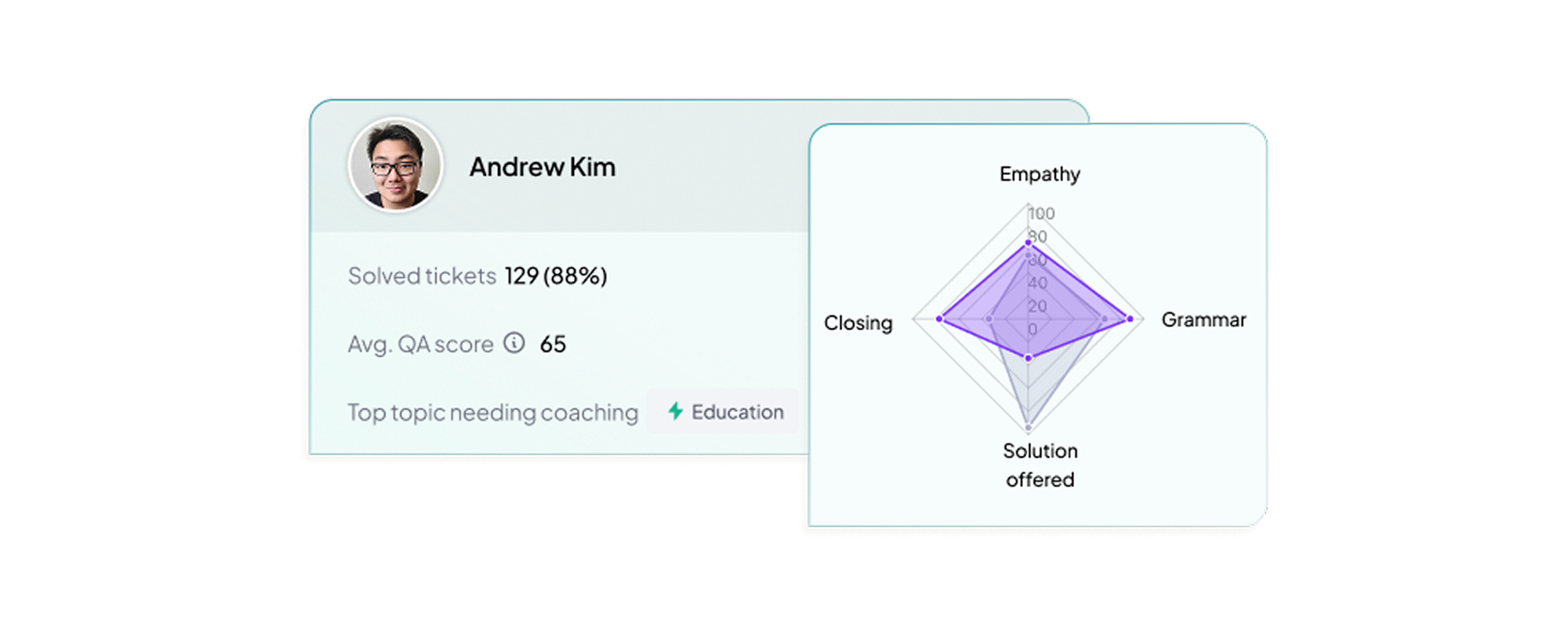
This is the area of closest parity. Both Forethought's Agent QA and Zendesk QA (from the Klaus acquisition in early 2024) do the same core thing: read 100% of conversation and score them on customisable metrics like resolution quality, technical accuracy, empathy and grammar. Both support custom scorecards. Both give agents performance dashboards and managers coaching insights.
The difference is what happens with the output. Zendesk QA currently stands alone. It measures, scores and reports. But those insights don't automatically feed back into the rest of the platform. Forethought's Agent QA does. Scores feed directly into Discover insights and trigger Autoflow improvements. A drop in resolution quality on a specific topic can surface a knowledge gap, which Discover picks up, drafts a fix for and deploys. That loop is automatic.
So while the QA feature sets are comparable, Forethought is further along the path of turning quality data into platform-wide improvement. That's the Resolution Learning Loop in practice, not just measurement.
Taken together, the pattern across all five agents is clear. There's meaningful overlap in what each platform does. But Forethought's advantage is that all five share a single architecture. Context flows between them. Autoflows run across them. Learnings from one feed improvements in another. That's the gap this acquisition fills.
Process at the centre, not tickets
The agent overview above compares features to features. But the bigger story is structural. This acquisition signals a shift in what sits at the centre of Zendesk. It used to be the ticket. Now it's the process.
If you've been following the Towards Automated Resolutions series on this blog, you'll recognise the trajectory. We've moved from tickets and replies to resolution paths built on knowledge, procedures and data. The question is no longer "who should reply?" but "what is the best way to resolve this?"
Forethought’s advanced capabilities perfectly align with our vision for agentic service. Together, we will be scaling self-improving AI that learns from every interaction. But technology is just the means. Resolution is our identity, and loyalty is the outcome. - Tom Eggemeier, CEO, Zendesk.
The fit with Zendesk's own direction is clear. Triggers are becoming Action Builder workflows. Macros are becoming Copilot procedures. Conversation flows are becoming adaptive reasoning with agentic procedures. Forethoughts' Autoflows slot into that same trajectory as the next step in how you define process in Zendesk. The process becomes the product.
Self-improving: the Resolution Learning Loop
Zendesk doesn't frame this acquisition around features. They frame it around a loop. Every interaction becomes a learning input. Complexity and volume train the system. Every resolution becomes a new baseline upon which to improve. They call it the Resolution Learning Loop.
Today, the improvement cycle is mostly manual. Admins monitor AI performance, spot gaps, then build new procedures or update knowledge. While our AI Assist gives you insights in what can be better, taking action on that is still manual work. It works, but it doesn't scale. As AI handles more interactions, the manual overhead of maintaining it grows too.
This is where Forethought's Discover comes in. As covered in the overview, it closes the full loop from gap detection to content creation to workflow generation. Zendesk has AI Insights that highlight potential issues. But that only partially goes from identifying a gap to drafting and deploying the fix. What we really want is that self-improving cycle Zendesk has been describing at Relate and the AI Summit. Forethought is what makes it real.
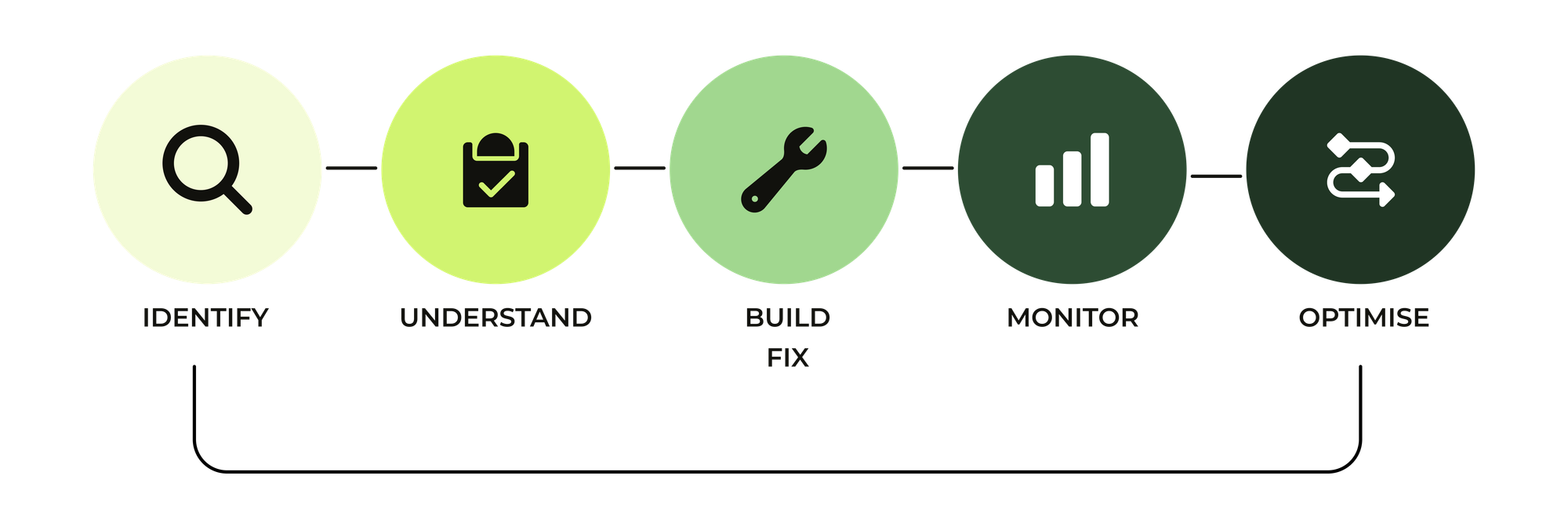
The implications for how teams operate are significant. The system learns from volume and complexity. Find the gap. Draft the fix. Deploy it. Measure. Repeat.
That's a fundamentally different operating model from what most support teams run today.
Expanding in the direction we're already going
Forethought is not a pivot. It's acceleration. Every major move Zendesk has made in the last 18 months points the same way.
Ultimate (March 2024) brought in LLMs and generative replies and became AI Agents Advanced. Local Measure (completed June 2025) brought enterprise voice infrastructure and became Zendesk for Contact Center. HyperArc (August 2025) brought AI-native analytics. Unleash will bring employee service search capabilities. Now Forethought brings the process layer, browser automation and cross-platform reach.
And all these acquisitions? There's all pointed to autonomous, AI-first service.
Zendesk projects that autonomous AI will handle more service interactions than humans by the end of 2026. Forethought is a big step toward making this real. It's feature set expands what's already been built, so once their tech and people gets incorporated into the existing Zendesk AI capabilities, well, they're turning it up to eleven.
Omnichannel: voice, messaging, email
Forethought's cross-channel consistency is a genuine differentiator. You build one Autoflow, and you can deploy it identically across chat, email, voice, SMS, Slack and API. No per-channel configuration. The unique part is the use case, not the channel.
Voice is historically one of the hardest channels to scale and learn from. Voice AI changes that by turning unstructured speech into actionable intelligence.
Forethought launched its voice capability in March 2025 via a partnership with Cartesia, a real-time voice AI company. No IVR trees. No hold queues. Same Autoflows as chat and email. Customisable voice personality with accent, tone, language and even hold music.
Zendesk announced its own voice AI agents in October 2025. Post-acquisition, these will likely merge or complement each other. But the underlying principle is the same. You build the process once. It runs everywhere.
This is consistent with where Zendesk has been heading since the messaging transition. Channels become interchangeable surfaces for the same underlying resolution logic. And it feeds back into the Resolution Learning Loop. Learnings from voice, including tone and sentiment markers that were previously impossible to capture at scale, feed the same improvement cycle as chat and email.
Headless
Forethought can run as a pure AI reasoning layer inside any interface. Via APIs or the Model Context Protocol (MCP), organisations can embed Forethought's intelligence into their own systems. No widget required. No (Zendesk) UI required. The customer's interface stays unchanged. Only the reasoning layer is Forethought's.
Zendesk has the Sunshine Platform and APIs for custom integrations. But nothing that works as a standalone headless reasoning engine you can embed anywhere. If we combine SunCo, App Builder and Forethoughts Headless APIs, I think customers will soon be able to build some pretty cool custom use cases on top of our platform.
Browser Agent fits here too. Only 24% of enterprise systems expose APIs, according to Postman's 2025 data. The remaining digital workflows are locked inside browser interfaces, inaccessible to traditional automation. Forethought's Browser Agent fills that gap by spinning up a secure browser session and operating directly inside web-based systems. It logs in, navigates, clicks, types and reads, just as a human agent would.
This is the "computer use" capability Zendesk called out in the acquisition announcement. It's net-new for the platform. And it means we can take actions even when no APIs are available.
Cross-platform
Forethought works natively on Salesforce, Intercom, Freshdesk and others. It was built from day one as a helpdesk-agnostic overlay. As Zendesk noted on their announcement, Forethought AI Agents by Zendesk will remain available as a standalone product with no requirement to use the Zendesk platform in its entirety.
If we take a step back this means we'll probably be seeing three types of companies leveraging Zendesk to drive their Employee or Customer service.

- We've got the companies that use Zendesk end-to-end. This is, traditionally, most of the existing Zendesk user base. They use Zendesk AI Agents, with their team working in Agent Workspace assisted by Agent Copilot, levering the entirety of the Resolution Platform.
- With the rise of modern AI Agents, there's also a set of companies that leverage Zendesk's platform (its ticketing, automations, and reporting) but use a different AI Agent to handle their first-line automation. Those might be home-brew solutions, or commercial tools like Forethought. And Zendesk's Sunshine Conversation platform and rich APIs allow this kind of setup.
- And thirdly, there's a new customer base that gets unlocked with Forethought. It's companies that are using a different platform to manage their conversations, but are looking for the best AI Agent to start automating these interactions. With Forethought, Zendesk offers them that capability.
This last one is arguably the most strategically interesting part of the deal. It turns Zendesk from a platform vendor into an AI vendor that happens to also have a platform. This makes Zendesk an AI layer across the entire CX market, offering solutions for customers that want just piece of the pie, or the entire solution.
Turning it up to eleven
While Forethought brings in a powerful set of integrated AI Agents, Zendesk has 17+ years of depth in ticketing, workflows and routing. It has Agent Workspace with Agent Home, giving agents full context of their interactions. It has native social messaging channels that Forethought doesn't cover natively. It has WFM from the Tymeshift acquisition. QA from Klaus. A full-featured help centre. A mature marketplace and developer ecosystem. Custom Objects, Action Builder, and the broader Sunshine Platform provide deep extensibility.
Forethought however sits on top of help desks. It isn't one. It doesn't host knowledge bases. It doesn't provide the operational infrastructure that Zendesk's core platform delivers. So while its Agentic capabilities will surely move Zendesk AI's goals forward, its the entire Resolution Platform that combines all these elements into a cohesive whole that will get you the results you drive towards.
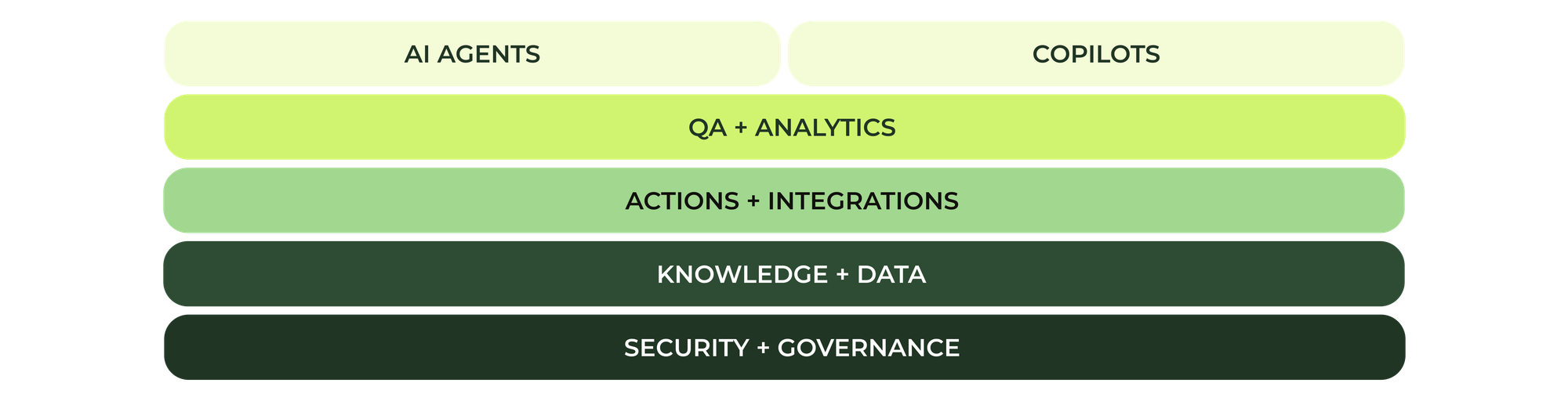
This Forethought acquisition is additive. It fills gaps in the product, or enriches existing capabilities. But like any acquisition, it doesn't replace the foundation.
This is an acquisition that turns the Resolution Platform into an operating system. One that learns, improves and extends itself across every channel, every interface and every helpdesk it touches.